How Tai Chi Quietly Changed My Recovery Game
After my injury, I thought movement was off the table—until I tried tai chi. What started as gentle daily motion became a game-changer in my rehab. No flashy moves, just slow, mindful flows that helped me rebuild strength and balance without strain. If you're healing and feeling stuck, this might be the missing piece. Let me walk you through how something so simple can make such a real difference. It wasn’t a dramatic shift, but over time, I noticed I could stand longer, move more freely, and feel less fear with every step. That quiet practice, done in silence or soft music, became the foundation of my return to everyday life.
The Moment Everything Slowed Down
Recovery after an injury often feels like a race with invisible walls. You want to move forward, but pain, stiffness, or fear holds you back. For months, I followed my physical therapist’s routine—targeted exercises, resistance bands, range-of-motion drills. They helped, but progress was slow, and frustration grew. Simple tasks like getting out of a chair or walking up stairs still felt uncertain. The fear of re-injury lingered, making me hesitant even when my body was ready to do more. I began to wonder if I’d ever feel steady again.
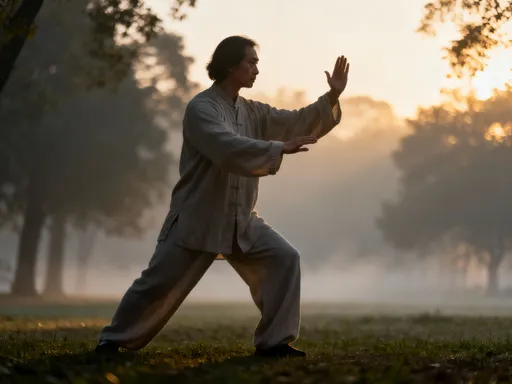
Then, during a community wellness event, I saw a small group moving together in unison—slow, flowing motions, feet gliding across the grass, arms rising like waves. It was a tai chi class for older adults and people in recovery. I watched, curious. It didn’t look like exercise. There were no jumps, no weights, no sweat. Just calm, continuous movement. Something about it felt different—not aggressive, not demanding, but deeply intentional. I remember thinking, Could this actually do anything? Still, I was skeptical. How could such slow motion rebuild strength or improve balance?
But I was tired of feeling stuck. The next week, I signed up for a beginner’s session. My first class was humbling. Standing in place, shifting weight from one foot to the other, I realized how much I had lost—not just strength, but awareness. Where was my center? How did my weight distribute? I couldn’t answer these questions. My body felt disconnected, like a machine with loose wires. Yet, the instructor didn’t push. She encouraged breathing, noticing, moving with care. There was no judgment, no rush. That week, I practiced five minutes a day at home. It wasn’t much, but it was a start. And slowly, something began to shift.
What Exactly Is Tai Chi—And Why It’s Not Just “Slow Dancing”
Tai chi is often misunderstood. To the untrained eye, it may look like graceful, slow dancing—people waving their arms in parks at sunrise. But it’s much more than that. Rooted in centuries-old Chinese philosophy and martial arts, tai chi is a practice of mindful movement, coordination, and breath control. It’s built on principles like softness overcoming hardness, continuity of motion, and the integration of mind and body. Unlike fast-paced workouts that focus on burning calories or building muscle, tai chi emphasizes quality of movement over speed or intensity.
Each movement flows into the next, creating a continuous sequence known as a form. These forms are designed to cultivate balance, flexibility, and internal awareness. The practice is grounded in the concept of qi—often translated as life energy or vital force—though you don’t need to believe in that concept to benefit from the physical mechanics. What matters is how the movements train your body to move with intention, control, and coordination. You’re not just moving your limbs; you’re learning how to align your posture, shift your weight smoothly, and breathe in rhythm with your motion.
Today, tai chi is recognized not just as a cultural tradition, but as a valuable tool in rehabilitation and chronic disease management. Health professionals increasingly recommend it for people recovering from injuries, managing arthritis, or improving balance to prevent falls. Unlike high-impact activities, it places minimal stress on joints while still engaging muscles and improving neuromuscular function. It’s not about force; it’s about awareness. And that makes it uniquely suited for people who are healing, not pushing.
Why Rehab Needs More Than Reps and Resistance
Traditional physical therapy is essential. It helps restore strength, flexibility, and joint function through targeted exercises. But it often focuses on the physical mechanics—muscles, tendons, ligaments—without fully addressing the nervous system’s role in movement. After an injury, your body doesn’t just lose strength; it can lose trust in movement. Pain signals create mental blocks. You start to avoid certain motions, not because they’re dangerous, but because your brain remembers the pain. This protective pattern can become ingrained, slowing recovery even after the tissue has healed.
This is where tai chi offers something different. It works on neuromuscular re-education—the process of retraining your brain to communicate effectively with your body. Because the movements are slow and controlled, they allow your nervous system to process each motion without triggering fear or stress. You’re not fighting against resistance; you’re relearning how to move with ease. Over time, this helps break the cycle of avoidance and hypersensitivity that often lingers after injury.
Additionally, tai chi emphasizes weight shifting, posture alignment, and coordinated breathing—all of which are often overlooked in standard rehab routines. While resistance training builds muscle, tai chi improves movement efficiency. It teaches you how to transfer force through your body smoothly, how to maintain balance during transitions, and how to move without unnecessary tension. These are subtle skills, but they’re critical for functional recovery—getting back to real-life activities like walking on uneven ground, carrying groceries, or bending down to tie a shoe.
The Real Magic: How Tiny Movements Create Big Shifts
The power of tai chi lies in its subtlety. Progress isn’t measured in reps or weights lifted, but in small, cumulative improvements. One of the first things I noticed was better balance. Simple weight-shifting exercises—like moving slowly from one foot to the other—began to strengthen my ankles and hips in ways that standard exercises hadn’t. Because the movements were slow, I could focus on alignment and control, not just completing the motion. Over weeks, I found I could stand on one leg longer, walk with more confidence, and feel more stable on slippery surfaces.
Joint mobility also improved. After my injury, my knee and hip felt stiff, especially in the morning. Tai chi’s flowing movements encouraged full-range motion without strain. Rotating the torso, gently bending the knees, and circling the arms helped lubricate the joints and reduce stiffness. Unlike stretching, which can sometimes feel forced, tai chi integrates mobility into natural, rhythmic patterns. This made it easier to stay consistent, even on days when my body felt tight.
Another key benefit was body awareness. I began to notice tension I didn’t know I was holding—clenched shoulders, shallow breathing, a tilted pelvis. Tai chi taught me to scan my body during movement, to release unnecessary effort, and to move with less resistance. This awareness translated into daily life. I caught myself standing with better posture, sitting more mindfully, and even sleeping more comfortably. Reduced muscle tension also meant fewer aches, especially in my lower back and neck.
Perhaps most importantly, tai chi helped me move without fear. Because each motion was small and controlled, I could test my limits safely. If something felt off, I could stop, adjust, and try again. There was no pressure to push through pain. This gradual, respectful approach rebuilt my confidence. I wasn’t just regaining function—I was relearning how to trust my body again.
Making It Work: Starting Small Without Overthinking
One of the best things about tai chi is that you don’t need special equipment, a lot of space, or prior experience. You can start in your living room, wearing comfortable clothes, with just a few minutes a day. The key is consistency, not perfection. In the beginning, I focused on just two or three simple movements—like Wave Hands Like Clouds or Parting the Horse’s Mane. These forms involve gentle arm sweeps, weight shifts, and turns, making them ideal for building foundational skills.
I used online videos designed for beginners and seniors, which broke down each movement step by step. Some classes were as short as five or ten minutes, which felt manageable on tough days. I also joined a local community center class once a week. Being in a group helped with motivation, and the instructor could offer gentle corrections. Even small adjustments—like aligning my knees over my toes or relaxing my shoulders—made a noticeable difference.
Safety is important, especially if you’re recovering from surgery or managing a chronic condition. I always moved within my comfort zone, avoiding any motion that caused pain. If a movement felt too challenging, I modified it—keeping the range smaller, moving slower, or using a chair for support. It’s not about doing it perfectly; it’s about doing it safely and consistently. I also kept my doctor informed, especially in the early stages, to ensure tai chi complemented my overall recovery plan.
Over time, I increased my practice to 15 or 20 minutes a day. I didn’t force it—some days were shorter, some longer. The goal wasn’t to achieve mastery, but to show up. And that small daily commitment added up. Within a few months, I could do a full 24-form sequence, but even more meaningful was how I felt in my daily life—more grounded, more balanced, more in tune with my body.
When Mind and Body Sync Up, Healing Speeds Up
Recovery isn’t just physical. The emotional toll of injury—frustration, anxiety, loss of independence—can be just as heavy. Tai chi helped me on that level too. The rhythmic breathing and flowing movements have a calming effect on the nervous system. With each session, I felt my stress levels drop. My heart rate slowed, my breathing deepened, and my mind quieted. It became a form of moving meditation, a daily pause in the noise of recovery.
Studies have shown that practices like tai chi can reduce cortisol, the stress hormone, and support better sleep and mood regulation. While I didn’t measure my cortisol levels, I could feel the difference. I slept more soundly. I reacted less to setbacks. I stopped obsessing over how far I had to go and started appreciating how far I’d come. That shift in mindset was crucial. Healing isn’t linear, and there were still bad days. But tai chi gave me a tool to reset, to return to center, to move forward with patience instead of pressure.
The connection between breath and movement was especially powerful. In tai chi, every motion is coordinated with inhalation or exhalation. This simple act creates a feedback loop between body and mind. When I focused on breathing deeply while moving, I felt more present, more in control. It reminded me that healing isn’t just something that happens to me—it’s something I can participate in, moment by moment.
This sense of agency made a big difference. Instead of feeling like a passive patient waiting to get better, I felt like an active participant in my recovery. That didn’t erase the challenges, but it changed my relationship with them. I wasn’t fighting my body anymore—I was learning to listen to it, trust it, and support it.
Not a Cure, But a Companion on the Road Back
Tai chi didn’t magically heal my injury. Medical care, physical therapy, and time did that. But tai chi became a quiet, consistent companion on the journey. It didn’t replace anything—it enhanced everything. It filled the gaps that traditional rehab sometimes leaves: the mental fatigue, the fear of movement, the loss of body awareness. It offered a way to stay active without overdoing it, to rebuild confidence without risk, and to find peace amid the frustration of recovery.
Everyone’s healing journey is different. What works for one person may not work for another. Tai chi isn’t a cure-all, and it’s not for everyone. But for those feeling stuck, hesitant, or worn down by the recovery process, it may be worth trying. It asks for very little—just a few minutes, a little space, and an open mind. In return, it offers something profound: a chance to reconnect with your body, to move with intention, and to rebuild not just strength, but trust.
If you’re healing, don’t underestimate the power of gentle movement. You don’t have to push harder to move forward. Sometimes, the quietest steps are the ones that carry you the farthest. Tai chi taught me that healing isn’t about force—it’s about flow. And in that flow, I found not just recovery, but a deeper appreciation for the resilience of the human body and spirit.